Tuesday, November 25, 2008

Let Detroit Go Bankrupt sounds cruel but ....

[Editor: It seems like a heartless thing to say knowing how many people are affected by the auto industry in North America. However when finances in a family, are not equal to expenses, then the family MUST do a make-over and start fresh.
  • New budgets need to be drawn up
  • Expenses need to be cut
  • "Needs" have to be prioritized over "Wants"
The American auto-makers are in that situation after being priced out of the market compared to better-made Japanese cars, yes the ones made in North America!

If the average North Big-3 auto-worker gets $77.53 per hour including benefits and the Japanese automakers in North America get $47.50 per hour, there can be NO competition. Unfortunately the NA unions have priced their workers out of their jobs.

Think about it for a minute: is one factory worker worth $30 more per hour than the other? Which cars top the lists for reliability and durability? Is it Japanese or North American? According to Consumer Reports, it is the Japanese that have had those two records for years now. While it is true that NA cars have improved due to the competition, they have had the albatross hanging around their necks of paying out about $240 more per worker per day!

Concessions by unions and a complete change of the top executives seems to be needed to condense the NA car industry into a competitive one. When cars first were being manufactured and buggy-manufacturers were losing business, did the government of the day bail out the buggy-makers? Mitt Romney has it right.]

From the New York Times .....
November 19, 2008 -Op-Ed Contributor

Mitt Romney writes in the NY times to

"Let Detroit Go Bankrupt"

Boston

IF General Motors, Ford and Chrysler get the bailout that their chief executives asked for yesterday, you can kiss the American automotive industry goodbye. It won’t go overnight, but its demise will be virtually guaranteed.

Without that bailout, Detroit will need to drastically restructure itself. With it, the automakers will stay the course — the suicidal course of declining market shares, insurmountable labor and retiree burdens, technology atrophy, product inferiority and never-ending job losses. Detroit needs a turnaround, not a check.

I love cars, American cars. I was born in Detroit, the son of an auto chief executive. In 1954, my dad, George Romney, was tapped to run American Motors when its president suddenly died. The company itself was on life support — banks were threatening to deal it a death blow. The stock collapsed. I watched Dad work to turn the company around — and years later at business school, they were still talking about it. From the lessons of that turnaround, and from my own experiences, I have several prescriptions for Detroit’s automakers.

First, their huge disadvantage in costs relative to foreign brands must be eliminated. That means new labor agreements to align pay and benefits to match those of workers at competitors like BMW, Honda, Nissan and Toyota. Furthermore, retiree benefits must be reduced so that the total burden per auto for domestic makers is not higher than that of foreign producers.

That extra burden is estimated to be more than $2,000 per car. Think what that means: Ford, for example, needs to cut $2,000 worth of features and quality out of its Taurus to compete with Toyota’s Avalon. Of course the Avalon feels like a better product — it has $2,000 more put into it. Considering this disadvantage, Detroit has done a remarkable job of designing and engineering its cars. But if this cost penalty persists, any bailout will only delay the inevitable.

Second, management as is must go. New faces should be recruited from unrelated industries — from companies widely respected for excellence in marketing, innovation, creativity and labor relations.

The new management must work with labor leaders to see that the enmity between labor and management comes to an end. This division is a holdover from the early years of the last century, when unions brought workers job security and better wages and benefits. But as Walter Reuther, the former head of the United Automobile Workers, said to my father, “Getting more and more pay for less and less work is a dead-end street.”

You don’t have to look far for industries with unions that went down that road. Companies in the 21st century cannot perpetuate the destructive labor relations of the 20th. This will mean a new direction for the U.A.W., profit sharing or stock grants to all employees and a change in Big Three management culture.

The need for collaboration will mean accepting sanity in salaries and perks. At American Motors, my dad cut his pay and that of his executive team, he bought stock in the company, and he went out to factories to talk to workers directly. Get rid of the planes, the executive dining rooms — all the symbols that breed resentment among the hundreds of thousands who will also be sacrificing to keep the companies afloat.

Investments must be made for the future. No more focus on quarterly earnings or the kind of short-term stock appreciation that means quick riches for executives with options. Manage with an eye on cash flow, balance sheets and long-term appreciation. Invest in truly competitive products and innovative technologies — especially fuel-saving designs — that may not arrive for years. Starving research and development is like eating the seed corn.

Just as important to the future of American carmakers is the sales force. When sales are down, you don’t want to lose the only people who can get them to grow. So don’t fire the best dealers, and don’t crush them with new financial or performance demands they can’t meet.

It is not wrong to ask for government help, but the automakers should come up with a win-win proposition. I believe the federal government should invest substantially more in basic research — on new energy sources, fuel-economy technology, materials science and the like — that will ultimately benefit the automotive industry, along with many others. I believe Washington should raise energy research spending to $20 billion a year, from the $4 billion that is spent today. The research could be done at universities, at research labs and even through public-private collaboration. The federal government should also rectify the imbedded tax penalties that favor foreign carmakers.

But don’t ask Washington to give shareholders and bondholders a free pass — they bet on management and they lost.

The American auto industry is vital to our national interest as an employer and as a hub for manufacturing. A managed bankruptcy may be the only path to the fundamental restructuring the industry needs. It would permit the companies to shed excess labor, pension and real estate costs. The federal government should provide guarantees for post-bankruptcy financing and assure car buyers that their warranties are not at risk.

In a managed bankruptcy, the federal government would propel newly competitive and viable automakers, rather than seal their fate with a bailout check.

Mitt Romney, the former governor of Massachusetts, was a candidate for this year’s Republican presidential nomination.

Copyright 2008 The New York Times Company

MOON and the National Post have it right!

[Not only does MOON get it right, but the National Post GETS IT RIGHT! I could not agree more. When unelected 'human rights' boards ignore our most fundamental right in a democracy, that of free speech, then it is time they get their wings clipped if not eliminating them entirely. Since they are not subject to the rules of evidence as in a court, they are open to personal demagoguery and board bias which has absolutely NO PLACE in a democracy. Any totalitarian government that has ever come to power came AFTER limiting the right of free speech! Socialistic, fascist or dictatorships; it does not matter, that is how they all start. Thanks to the NP for airing the truth.]

The National Post editorial board states that "The Moon report gets it right"
Posted: November 24, 2008

‘The principal recommendation of this report is that section 13 be repealed so that the censorship of Internet hate speech is dealt with exclusively by the criminal law.” We can’t recall the last time reading 28 words gave us such an exquisite frisson.

On Monday, the Canadian Human Rights Commission (CHRC) released a consultant’s report calling for the federal human rights police to lose their power to censor speech on the Internet and in other forms of media. We wholeheartedly concur, and urge the federal government to pass legislation bringing about this change now, rather than waiting until after the drawn-out public consultation process proposed by the CHRC itself.

We will admit we had concerns initially about the ability of Richard Moon, a University of Windsor law professor, to conduct an impartial review of the commission’s hate speech powers. He had occasionally in the past expressed what might be described as a collectivist view of freedom of expression — one that appeared to put the desire to protect minorities from insult ahead of the individual’s right to speak his or her mind boldly. Before his selection, Prof. Moon had written that speech has a “social character,” with great “potential for harm.” If left unchecked, “it can cause fear, it can harass and it can undermine self-esteem.”

Monday, November 10, 2008

Radio-Canada Agrees to Air New Documentary

Radio-Canada Agrees to Air New Documentary

November 10, 2008


Dear HonestReporting Canada subscriber:

On October 31, we questioned why Radio-Canada, the French-arm of CBC, had aired the pro-Palestinian advocacy film "Peace, Propaganda and the Promised Land" on its documentary program "Les grands reportages". We felt that in airing this film, Radio-Canada failed to inform its viewers that the "documentary" was not an objective study of media coverage of the Arab-Israeli conflict, but instead was a pro-Palestinian advocacy tool with a political agenda, rife with errors and omissions that have seriously misled Canadians.

Thanks to your many emails, Radio-Canada acknowledged that their host's introduction was poorly presented and out of context given Israel's withdrawal from the Gaza Strip in 2005. Furthermore, the network committed to air additional "documentaries providing different perspectives on the situation in Israel and Gaza" in the coming months. Many of our members who complained to Radio-Canada received the following reply from their Director of Complaints for French Services, which noted among other things, that the film was "clearly pro-Palestinian":

"Dear Sir or Madam,   


We received your comments about the documentary Peace, Propaganda & the Promised Land, whose French version aired October 23 on RDI as part of Les grands reportages.


First, allow me to briefly explain the context in which we air documentaries. It is an acknowledged fact that with the documentary format, the author's perspective forms a significant part of the production. In nearly all cases, these films are shot by directors with no affiliation to Radio-Canada. We choose to broadcast them because we feel they contain noteworthy information.


In airing point-of-view documentaries, Radio-Canada is not endorsing the opinions they contain. Rather, we are fulfilling our duty to reflect a diverse range of viewpoints on topics of public interest.


Peace, Propaganda & the Promised Land contained relevant information for Canadians about how the Israeli-Palestinian conflict is covered in the US media. It was a US-made documentary produced by the Media Education Foundation and distributed by Mundovision.


That said, the film is a partial update of a documentary shot four years ago, before Israel withdrew from Gaza. Consequently, our introduction should have placed it in the context of 2004, rather than present it as reflecting the current challenges of the Middle East in the run-up to the 2008 US presidential election.


It did indeed present a highly personal point of view on the conflict-one that we acknowledge was clearly pro-Palestinian. Rest assured that we have recently acquired other documentaries providing different perspectives on the situation in Israel and Gaza, which we plan to air in the coming months.


I hope you find these comments satisfactory. If not, and should you see fit to do so, you may ask the CBC/Radio-Canada French Services Ombudsman to review the case.


Best Regards,


Geneviève Guay, Director, Complaints Handling Information, French Services"


While we credit Radio-Canada for acknowledging that their introduction of the film was placed out of context and for agreeing to air additional documentaries to provide a range of different perspectives on the Mideast, notwithstanding, this issue isn't about achieving equitable balance over time as our original complaint contended. Airing a "Pro-Israel" documentary at a later date doesn't absolve the network for its original sin in airing a "pro-Palestinian" propaganda film rife with errors and replete of serious omissions. It could be reasonably argued, that had our members and the community at large not taken action in the first place, prompting Radio-Canada to air an additional documentary, only a pro-Palestinian perspective would have been disseminated to Radio-Canada's viewing audience.

By broadcasting this film, Radio-Canada abdicated its responsibility as a public broadcaster to do the necessary quality control checks which should have ensured that this pro-Palestinian advocacy film was not aired in the first place. As the film certainly didn't adhere to Radio-Canada's journalistic standards for "point-of-view documentaries in the sense of advocacy", in order for Radio-Canada to remedy this situation in a way that maintains its credibility, it's incumbent upon the network's Ombudsman to formally review this matter.
 
What You Can Do To Make A Difference:
 
By voluntarily disclosing its journalistic lapses and how it will prevent them in the future, Radio-Canada can strengthen its credibility and become a stronger news organization.

Ask Radio-Canada Ombudsman Ms. Julie Miville-Dechene to conduct a formal review of Radio-Canada's October 23 presentation of the film "Peace, Propaganda and the Promised Land" to determine if the network's presentation of the film adhered to Radio-Canada standards of broadcasting and codes of ethics. Please send letters to ombudsman@radio-canada.ca or call (514) 597-4757 to ask for a review.

 
HonestReporting.ca
 
To support our continued efforts to hold the Canadian news media accountable for their reporting on Israel, please donate here today. Through your donations, you can help ensure that Canadian journalists are held to the highest standards of "Honest Reporting."
 
 
Or send a cheque to:
 
HonestReporting Canada
PO Box 6, Station Q
Toronto, Ontario M4T 2L7
(416) 915-9157

Thank you for your ongoing commitment to fair and accurate
media coverage of Israel and the Middle East

 
Get Involved Today
                                    HonestReporting Canada
                PO Box 6, Station Q, Toronto, ON, Canada M4T 2L7
                                   
info@honestreporting.ca

You are currently subscribed to honestreportingcanada as: pressing4truth.canada@blogger.com
To unsubscribe click here
or send a blank email to leave-8466260-30846861.70055780e4c7785a46ecfd4be95feb9c@pr1.netatlantic.com

Friday, October 31, 2008

Radio-Canada Wrong In Airing Pro-Palestinian Advocacy Film

Radio-Canada Wrong In Airing Pro-Palestinian Advocacy Film

October 31, 2008

 
Dear HonestReporting Canada subscriber:
 
 
On October 23, Radio-Canada, the French arm of the CBC, aired the pro-Palestinian advocacy film "Peace, propaganda and the promised land" on its documentary film program "Les grands reportages". By airing a film rife with false premises, serious omissions, and unfounded malicious allegations, the network not only misinformed Canadians about the politics and history of the Middle East, it also breached its own journalistic standards and practices by airing a one-sided partisan polemic bent on vilifying a fellow democracy, the state of Israel.
 
Introducing the film, Radio-Canada host Simon Durivage's rhetorical questions and leading opinions parroted the film's anti-Israel thesis. To view the introduction click here or on the image below.
 

(Note: HRC English translation appears below)

Durivage: "Peace, propaganda and the promised land. Do the American media view Israeli settlement of occupied territories as a defensive gesture only? ... According to Middle East experts, for forty years, the settlement policy of the Hebrew state has grown inside the occupied Palestinian territories. Result: daily violence on both the Palestinian and Israeli side. So what message do the American media convey regarding this interminable conflict? Do they distort the judgment of our southern neighbours?"

Ironically, it's Radio-Canada and Durivage who have distorted the judgment of Canadian viewers by presenting the Arab narrative as fact by exclusively blaming violence on Israeli settlements and ignoring all other possible causes for the conflict.

The film, which was produced in 2003/4 by the Media Education Foundation, an advocacy group whose mandate is to "answer the challenge posed by the radical and accelerating corporate threat to democracy" and whose board of advisors includes the likes of notorious anti-Israel activists like Noam Chomsky and Naomi Klein, claims to show "the foreign policy interests of American political elites - working in combination with Israeli public relations strategies - exercise a powerful influence over news reporting about the Middle East conflict."

To view the "documentary" in its entirety (80-minutes in length) please click here or on the image below. (Note: Radio-Canada aired an edited down and more condensed one-hour version of the film with French-language voice-overs)

A New York Times review of the film found that the "pro-Palestinian documentary attempts to prosecute Israel in the court of U.S. public opinion", while noting that the "documentary largely ignores Palestinian leadership, which has surely played a part in the conflict's broken vows and broken hearts. And such a lack of dispassion weakens the one-sided film's bold and detailed argument."

Likewise, a scholarly analysis of the film by Yitzhak Santis, the Director of Middle East Affairs for the Jewish Community Relations Council (JCRC) in 2004, noted that the film was full of "decontextualizations, disinformation, selective emphasis and blatant lies, lack of balancing perspectives, lack of citations/documentation to back up assertions of facts, omission of facts, and straw man argumentations." To read the full report online please click here.

Among its many flaws, the film presents quotes from radical anti-Israel activists presenting them as if they were objective commentators to the conflict, it shows a series of news reports out of context and without explanation, and makes blanket statements about Israeli/Jewish attempts to control the media which are baseless and without merit. Furthermore, the film virtually ignores terrorism against Israeli civilians and the very well known Palestinian intimidation of the press.

Santis' report concludes by noting that "It should be incumbent upon public television stations that hold the trust of its viewers to promote "truth in packaging" by informing its audience that this is not an objective study of media coverage of this conflict, but an advocacy piece with a political agenda."

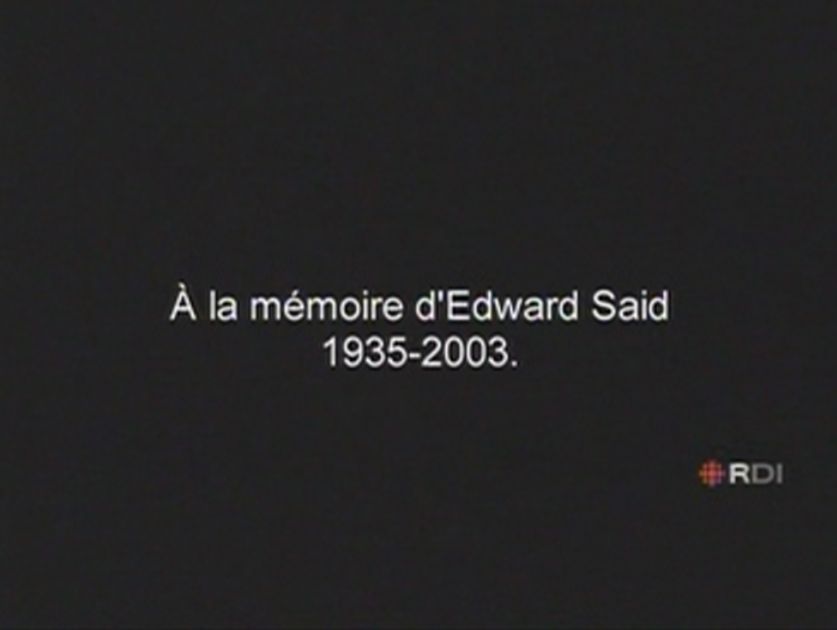
The film, which offered "special thanks" in its credits to pro-Palestinian organizations like: Electronic Intifadah, Al Awda, International Solidarity Movement, and the Arab American Anti-Discrimination Committee, was also dedicated in the memory of famous pro-Palestinian activist Edward Said.

At a bare minimum, Radio-Canada should have tested the program against the organization's guidelines for "point-of-view documentaries in the sense of advocacy". According to Radio-Canada's guidelines for Journalistic Standards and Practices:

"Great caution should be taken to protect the integrity of the Corporation's impartiality in information programming and its independence of special interest groups... In considering such works of opinion or argument for broadcast, the CBC (read Radio-Canada) has to assure fairness and balance by other means. The CBC should also guard against political or economic interest groups and lobbies exploiting this avenue."

Radio-Canada asks its own programmers to apply various tests when deciding whether or nor to feature a particular documentary. It asks programmers to ensure that "a production should be of particular excellence and pertinence in the eyes of the CBC", that the film "should be prominently identified as a work of opinion at the beginning and at the end", that the "CBC must be completely satisfied that this work is financed independently from any party having a direct interest in the issue", that facts should be "respected and arguments should reasonably flow from those facts... to ensure that the argument presented does not rest on false evidence", and finally that "the broadcast of a clearly partisan production from a single perspective obligates the CBC to provide an appropriate reflection of other pertinent points of view."

Using the national broadcaster's own guidelines, the film can't be defined as being of a "particular excellence" given its numerous errors and misrepresentations and its clear nature as an advocacy piece for pro-Palestinian propaganda purposes. Finally, as Radio-Canada has failed to provide alternative perspectives, the network failed to give "an appropriate reflection of other pertinent points of view" as a counterbalance.

Radio-Canada has abdicated its responsibility to do the necessary due diligence and quality control checks which should have ensured that this film was not aired in the first place. While we do not endorse actions to censor the media, by the fact that this film failed to live up to Radio-Canada's own litmus test for documentary standards, it is incumbent upon the network to atone for its mistake in news judgment for airing this shoddy pro-Palestinian advocacy film.
 
What You Can Do To Make A Difference: 

Tell Radio-Canada that its October 23 broadcast of "Peace, propaganda and the promised land" on "Les grands reportages" failed to inform its viewers that the film was not an objective study of media coverage of the Arab-Israeli conflict, but a pro-Palestinian advocacy tool with a political agenda, rife with errors and omissions that have seriously misled Canadians.

Ask Radio-Canada to apologize, to conduct a formal review, and to implement stricter quality control protocols to ensure that this doesn't happen again. Please send polite and rational emails to Radio-Canada Ombudsman Julie Miville-Dechene at ombudsman@radio-canada.ca or call (514) 597-4757 to voice your concerns.
 
HonestReporting.ca
 
To support our continued efforts to hold the Canadian news media accountable for their reporting on Israel, please donate here today. Through your donations, you can help ensure that Canadian journalists are held to the highest standards of "Honest Reporting."
 
 
Or send a cheque to:
 
HonestReporting Canada
PO Box 6, Station Q
Toronto, Ontario M4T 2L7
(416) 915-9157
 
Thank you for your ongoing commitment to fair and accurate
media coverage of Israel and the Middle East
 
Get Involved Today
                                    HonestReporting Canada
                PO Box 6, Station Q, Toronto, ON, Canada M4T 2L7
                                   
info@honestreporting.ca

You are currently subscribed to honestreportingcanada as: pressing4truth.canada@blogger.com
To unsubscribe click here
or send a blank email to leave-8357220-30846861.70055780e4c7785a46ecfd4be95feb9c@pr1.netatlantic.com

Tuesday, September 16, 2008

CBC Critically Examines Israel's Enemies

CBC Critically Examines Israel's Enemies

September 16, 2008

By: Mike Fegelman

Dear HonestReporting Canada subscriber:
 
More often than not, the Canadian and international media have sought fit to report on the Arab-Israeli conflict through the narrow lens of the Israeli-Palestinian conflict.
 
Reporting on the pervasive violence between Israelis and Palestinians, Western journalists employ conventional black and white narratives to a conflict which deserves colour, context, and clarity.
 
Whether as a result of a lowest common denominator way of thinking or due to a lack of contrarian thought, this dogmatic approach adopted by the Mideast media deceives news consumers into thinking they're getting a fair and complete representation of the region.
 
The result: Israel's legitimate security concerns get short shrift, Arab vs. Arab violence gets under reported, and human rights continue to be ignored in the broader Middle East.
 
When our public broadcaster, the CBC, went beyond this Mideast "conventional wisdom" and featured critical reporting on the Iranian nuclear threat and on the dangers of Hamas' rule in Gaza, it's important that we pause, take note, and expose excellence when it's deserving.
 
Iran's Existential Threat to Israel
 
On the August 27 edition of CBC's "The National," reporter Terry Milewski documented what a Persian night in Jerusalem would be like for the over 60,000 Iranian Jews now living in Israel, even though as he acknowledged "Iran's president threatens to wipe Israel off the map."
 
Milewski painstakingly analyzed the existential threat that Iran's nuclear program poses to Israel. He rhetorically asked: "But it's not just the Iranian Jews who are intensely interested in all things Persian. Israel, and the world beyond, is debating the looming question: should Israel strike at Iran's nuclear facilities before the mullahs get the bomb?"
 
To view the full 8-minute report please click here or on the image below:


On CBC.ca, Milewski adapted this feature segment into a "Report From Abroad." In it he interviewed Menashe Amir who has been broadcasting to Iran on Israel's state-run radio for 48 years.
 
According to the report: "Amir said the West has failed to understand the Iranian threat. He believes the regime is opposed by most Iranians but is consumed by an apocalyptic vision: the triumph of Shia Islam [also known as Shiite] over the world. 'Western governments', he says, don't see that, for the Iranian mullahs, the destruction of the Jewish state is just a step along the way... But Amir points out, on the same day, in the same speech that Ahmadinejad called for wiping off Israel from the map, he added that the destruction of Israel is the first step of our final confrontation with western civilization... Amir says the regime dreams of a new caliphate - an Islamic empire spanning the globe."
 
In focusing a critical lens on the Iranian threat, Milewski's candid and thought provoking analysis brought necessary context to what could be an inevitable military confrontation between Israel and Iran.
 
The Specter of Hamastan
 
On the September 1 and 4 editions of CBC News Sunday and CBC Around the World, Milewski continued his whirlwind trip to the region with a second feature-length report. This time he analyzed the threat that Hamas poses in making the Gaza Strip a full-blown Islamic state.
 
Milewski set the tone of his report with an upfront acknowledgment that Hamas' well-oiled propaganda machine was playing it up for the CBC's cameras:
 
"In Gaza, the Islamic warriors of Hamas are preparing for war. At least it looks like they are, but in truth this is theatre. It's a photo-op to show the foreign media that Hamas is building an army to destroy the state of Israel. Such photo-op's are frequent since Hamas seized power in Gaza last year..."
 
To view the full 5-minute report please click here or on the image below:


His exclusive report (which was also adapted on CBC.ca) chronicled Hamas' intimidation of the media and Palestinian society at large, their threats to Palestinian security and stability as Hamas continues to "aim its guns inward." Milewski noted that Hamas really has "no program to end Gaza's isolation," how it refuses to recognize Israel, is boycotted as a terrorist organization, and how ordinary Palestinians desperately want peace with the Jewish state.
 
Milewski's in-depth report saw him secure an exclusive interview with Hamas co-founder Mahmoud Zahar, (see photo above) whose irrational comments were almost laughable. Milewski noted that Zahar "Isn't going to evolve" and that for the "ideologists of Hamas... the goal is the extinction of Israel."
 
In conclusion Milewski boldly notes: "This in a nutshell, is Gaza's problem. Instead of adapting to its environment, Hamas expects the environment to change. As long as Hamas threatens to destroy Israel, Gaza remains isolated and wretched. Many Gazans will blame Hamas as well as Israel. So Hamas may have to keep its guns pointing inward."
 
How You Can Make A Difference
 
It's human nature that we're more likely to criticize than to give acclaim, but when investigative reporting reflects the highest standards of newsgathering, it's important that we recognize excellence. Terry Milewski's recent reporting on the threats that Iran and Hamas pose to Israel deserve to be commended.
 
Please send your considered comments to the CBC's Audience Relations department and refer to Terry Milewski's September 1 report on Hamas and his August 27 report on Iran.
 
 
HonestReporting.ca
 
To support our continued efforts to hold the Canadian news media accountable for their reporting on Israel, please donate here today. Through your donations, you can help ensure that Canadian journalists are held to the highest standards of "Honest Reporting."
 
 
Or send a cheque to:
 
HonestReporting Canada
PO Box 6, Station Q
Toronto, Ontario M4T 2L7
(416) 915-9157
 
Thank you for your ongoing commitment to fair and accurate
media coverage of Israel and the Middle East
 
Get Involved Today
                                    HonestReporting Canada
                PO Box 6, Station Q, Toronto, ON, Canada M4T 2L7
                                   
info@honestreporting.ca

You are currently subscribed to honestreportingcanada as: pressing4truth.canada@blogger.com
To unsubscribe click here
or send a blank email to leave-7930289-30846861.70055780e4c7785a46ecfd4be95feb9c@pr1.netatlantic.com

Thursday, August 21, 2008

Countering Canadian Media Canards

Countering Canadian Media Canards

August 21, 2008

By: Mike Fegelman

 
Dear HonestReporting Canada subscriber:

In recent weeks, the Canadian media has largely ignored the Middle East file.

News coverage has been largely dominated with extensive reporting on the Beijing Olympics and wall-to-wall coverage of the battle for South Ossetia. That being said though, several Canadian media outlets including La Presse, CBC, and City TV, carried inaccurate reports and echoed activist's vicious canards which needed to be countered.

The following are several examples where HRC intervened to ensure fair and accurate coverage of Israel.
 
The Myth of Occupied Gaza

A popular myth continues to be promulgated by Israel's enemies and accepted as fact by the international and Canadian media.

Proponents from the International Solidarity Movement (ISM) and the Montreal-area group Palestinian and Jewish Unity (PAJU) continue to claim that Israel is an occupying force of the Gaza Strip.

Contrary to their allegations, occupation implies being able to impose your will on the occupied and as Israel disengaged from Gaza, removing over 8,500 settlers in the summer of 2005 and as it doesn't have any soldiers on the ground, this claim does not have any merit. Although Israel does carry out military incursions to thwart and disrupt terror cells, this does not qualify as "occupation," nor does any other claims that because Israel controls the sea/air access to Gaza that it's an "occupier."

Currently, the only non-Palestinian force in Gaza is the UN and we don�t presume that the media would claim that it's "occupying" the Gaza Strip.

On July 31, both CBC.ca and La Presse regurgitated these baseless claims from ISM and PAJU and presented them both as fact. After HonestReporting Canada intervened, the following corrections were issued by both respective media outlets on August 5 and 18:

For more information on how you can counter the "occupation" slur, please see a scholarly analysis by Washington lawyers David B. Rivkin Jr. and Lee A. Casey entitled "The Myth of Occupied Gaza" as printed in the Washington Post.

An Unforgivable Error and a Dismal "On-Air" Correction at City TV

The August 14 broadcast of CityTV International carried a short report that caught our attention.

The report centered on recent clashes at the construction site of the security barrier near Nilin, West Bank, between pro-Palestinian protestors and Israelis soldiers. City TV host Gord Martineau erroneously reported the following:

  • "At least 11 people were killed at clashes between Israeli troops and protestors in a site at Israel�s controversial separation barrier in the West Bank."

To watch the report online please click on the image below.

Contrary to this statement, there were no deaths at clashes this past Thursday at Nilin. Instead, and as the Israeli newspaper Yedioth Ahronot confirms, several "protestors were reportedly hurt during clashes with forces in the area."

This City TV report left viewers with the false impression that Israeli soldiers killed 11 protestors who were involved in an altercation at the barrier site. In consideration for the especially serious nature of this mistake, we asked City TV to issue an on-air correction to remedy this error.

On August 18, the program issued the following "on-air" correction that appeared only in a text- super in the program's broadcast on other Mideast matters. It read as follows: "CNI (City News International) REPORT THURS. INDICATED 11 KILLED IN W. BANK CLASHES, MORE THAN 11 HURT, NOT KILLED."

To watch the "on-air" correction please click on the image below. (Note: We apologize for the low-resolution image and video)

If City TV were genuinely interested in setting the record straight, we would have expected their host to verbally orate the correction instead of carrying it as a short super embedded within another report, this time about Israel's efforts to release 200 Palestinian prisoners from Israeli jails. Most viewers probably didn't even notice the correction in the first place and even if they did, the language of the correction was so tersely worded that it wouldn�t have even come across as a correction.

Many City TV viewers are still left with the false impression that Israeli soldiers bellicosely killed 11 pro-Palestinian protestors at last week�s clashes at Nilin. If you feel inclined to voice your concerns about City TV�s dismal August 18 correction, please send polite, rational, and considered comments to City TV publicist Veronica Logue at: veronica.logue@rci.rogers.com

Notwithstanding, after receiving commitments from all three news organizations: City TV, La Presse, and CBC, to be more vigilant in the future when vetting reports for publication and for broadcast, we are satisfied that our concerns were addressed and given high priority by these Canadian media outlets.
 
 
HonestReporting.ca
 
To support our continued efforts to hold the Canadian news media accountable for their reporting on Israel, please donate here today. Through your donations, you can help ensure that Canadian journalists are held to the highest standards of "honest reporting."
 
 
Or send a cheque to:
 
HonestReporting Canada
PO Box 6, Station Q
Toronto, Ontario M4T 2L7
(416) 915-9157
 
Thank you for your ongoing commitment to fair and accurate
media coverage of Israel and the Middle East
 
Get Involved Today
                                    HonestReporting Canada
                PO Box 6, Station Q, Toronto, ON, Canada M4T 2L7
                                   
info@honestreporting.ca

You are currently subscribed to honestreportingcanada as: pressing4truth.canada@blogger.com
To unsubscribe click here
or send a blank email to leave-7542469-30846861.70055780e4c7785a46ecfd4be95feb9c@pr1.netatlantic.com

VIDEO:Canada Human Rights

VIDEO of CTV PowerPlay Canada Human? Rights Commission?

Iranian S-Elections?

Evolution / Intelligent Design

Legitimate Questions Should Be Discussed

I am reminded of how established "science" has been wrong many times before such as in the case of Piltdown man. So could it be wrong now? Or has it been perfected? Should not reasonable arguments be considered?

We have become a nation of beggars

Terence Corcoran reports in the National Post on Friday, January 16, 2009 that the STIMULUS everyone is yelling for may only work over a short period and may actually MAKE THE ECONOMY WORSE over longer periods.

[Read the article below for the researchers who studied this phenomenon.]

POINTS

- "What if, as a wide and growing school of economists now suspect, the government spending and stimulus theory is a crock that is shovel-ready to be heaved out into the barnyard of economic waste?"

- Even disciples of Keynes, such as Harvard's Greg Mankiw, recently highlighted economic studies that show government spending binges -- shocks, they are sometimes called -- don't seem to help the economy grow. They might even make it worse.

-One of the studies cited by Mr. Mankiw was by two European economists (Andrew Mountford and Harald Uhlig), titled "What are the Effects of Fiscal Shocks?" It looked at big deficit-financed spending increases and found that they stimulate the economy for the first year, but "only weakly" compared with a deficit financed tax cut. The overriding problem is that the deficits crowd out private investment and, over the long run, may make the economy worse. "The resulting higher debt burdens may have long-term consequences which are far worse than the short-term increase in GDP."

-A paper by two economists, including the current chief economist at the International Monetary Fund, Olivier Blanchard, concluded that increased taxes and "increases in government spending have a strong negative effect on private investment spending."

-Roberto Perotti, an Italian economist with links to Columbia University, in "Estimating the Effects of Fiscal Policy in OECD Countries," found nothing but bad news for Keynesians. Economic growth is little changed after big increases in government spending, but there are signs of weakening private investment.

- What we all might logically intuit to be true -- spend government money, especially borrowed money, and you stimulate growth -- has long been thought to be a fallacy by some economists. That thought is now spreading. British economist William Buiter said the massive Obama fiscal stimulus proposals "are afflicted by the Keynesian fallacy on steroids."

The whole article by Terrance Corcoran follows:

Are you "shovel-ready," poised to hit the ground running, or merely desperate for cheap cash to get through the recession? If so, here's your last chance to apply to Ottawa for a piece of the massive government spending-bailout-infrastructure-stimulus operation now being prepared for Finance Minister Jim Flaherty's Jan. 27 budget extravaganza.

To get you going, the National Post has created an all-purpose Stimulus Canada application document. Simply make sure your company/institution fills out the form here to get in on the action.

We're just kidding, of course, or at least we were until our satirical Stimulus Canada General Application Form was mugged by reality, which is rapidly turning out to be funnier than the fanciful idea of a government department called Stimulus Canada. To all intents and purposes, Stimulus Canada already exists.

Government money to flow, the taps are opening, deficits are no problem. The spending, as Stephen Harper said after a meeting with the premiers on Friday, will be "very significant" and there will be "very significant deficits." That could mean new spending of $20-billion and deficits of $40-billion.

Industry groups, corporate opportunists, charities, municipal politicians, arts groups, provincial premiers, tech firms, mining companies, forestry operators, banks, money lenders -- in fact, just about everybody has come forward to get in on Canada's portion of what is turning out to be a mad global government stimulus pandemic.

Each claims to have a plan or an idea that they say would produce jobs, spending, investment and activity that would get Canada through the recession and stimulate the economy.

At some point, though, the clamour of claims and calls becomes absurd, and that point looks to have been crossed the other day in the United States when porn merchant Larry Flint said the U.S. sex industry was falling on hard times, business was down 25%, and it needed a $5-billion slice of the $1.2-billion U.S. stimulus program.

And why not?

Mr. Flint has a point. It is not totally illogical for anyone to think that way. If you spend a dollar somewhere -- whether building a bridge or operating a forest company or buying a car -- it generates activity. And, after all, it's a grand old economic theory, created by John Maynard Keynes, that spending, especially government spending, rolls through the economy on a giant multiplier, piling jobs on jobs, growth on growth.

Except for one problem: What if it's not true? What if, as a wide and growing school of economists now suspect, the government spending and stimulus theory is a crock that is shovel-ready to be heaved out into the barnyard of economic waste?

The Prime Minister, in his comments on Friday, seemed to be riding right into the barnyard. He said the government would be simply "borrowing money that is not being used" and "that business is afraid to invest." By borrowing that money, and turning it over to all the groups and interests looking for part of the stimulus spending, he would be jump-starting activity while the private sector got its legs back.

Even disciples of Keynes, such as Harvard's Greg Mankiw, recently highlighted economic studies that show government spending binges -- shocks, they are sometimes called -- don't seem to help the economy grow. They might even make it worse.

One of the studies cited by Mr. Mankiw was by two European economists (Andrew Mountford and Harald Uhlig), titled "What are the Effects of Fiscal Shocks?" It looked at big deficit-financed spending increases and found that they stimulate the economy for the first year, but "only weakly" compared with a deficit financed tax cut. The overriding problem is that the deficits crowd out private investment and, over the long run, may make the economy worse. "The resulting higher debt burdens may have long-term consequences which are far worse than the short-term increase in GDP."

Two other studies point in the same direction. A paper by two economists, including the current chief economist at the International Monetary Fund, Olivier Blanchard, concluded that increased taxes and "increases in government spending have a strong negative effect on private investment spending."

Roberto Perotti, an Italian economist with links to Columbia University, in "Estimating the Effects of Fiscal Policy in OECD Countries," found nothing but bad news for Keynesians. Economic growth is little changed after big increases in government spending, but there are signs of weakening private investment.

What we all might logically intuit to be true -- spend government money, especially borrowed money, and you stimulate growth -- has long been thought to be a fallacy by some economists. That thought is now spreading. British economist William Buiter said the massive Obama fiscal stimulus proposals "are afflicted by the Keynesian fallacy on steroids."

Over at Stimulus Canada, Mr. Harper's plan looks somewhat more modest and Canada is not in the same fiscal fix as the United States. But Ottawa and the provinces are clearly ready to borrow big wads of money from the future to stimulate the economy today. It's money that is supposedly sitting out there in the timid hands of investors who will be repaid with tax dollars later.

But if that stimulus spending does not generate much fresh economic growth, and the borrowing chews up money that private investors could invest in the future, the shovel-ready brigades who get the cash today will produce only short term gains at the expense of the long term health of the economy.

Educational Purposes Only

All articles quoted here are for educational purposes only. Canada-For-Truth encourages you to read the original articles on their respective sites.
We do not necessarily agree with all links posted here but we include them to bring balance to an unbalanced media.